

Building a custom home is an exciting milestone, but the most common question every future homeowner asks is: How long is this going to take?
Accurately calculating home construction time is crucial. It dictates your temporary living arrangements, affects your construction loan interest rates, and sets realistic expectations for your family. While every build is unique, you can calculate a reliable timeline by understanding industry baselines, construction phases, and key variables.
The Baseline: What is the Average Home Construction Time?
According to data from the U.S. Census Bureau’s Survey of Construction, building a single-family home typically takes 7 to 12 months from breaking ground to the final move-in date.
However, this timeline depends heavily on the type of build:
- Production / Tract Homes: 4 to 6 months (built by developers using pre-designed floor plans in a subdivision).
- Semi-Custom Homes: 6 to 9 months (pre-designed plans with customized interior/exterior options).
- Fully Custom Homes: 12 to 18+ months (completely unique designs tailored to a specific lot).
Phase-by-Phase Breakdown of the Home Building Process
To calculate your construction schedule, you need to map out the duration of each distinct phase.
| Phase | Estimated Duration | What Happens? |
| 1. Pre-Construction & Planning | 1 to 3 months | Architectural designs, engineering, budgeting, permits, and HOA approvals. |
| 2. Site Prep & Foundation | 2 to 4 weeks | Land clearing, grading, excavation, pouring footings, and concrete slabs or crawlspaces. |
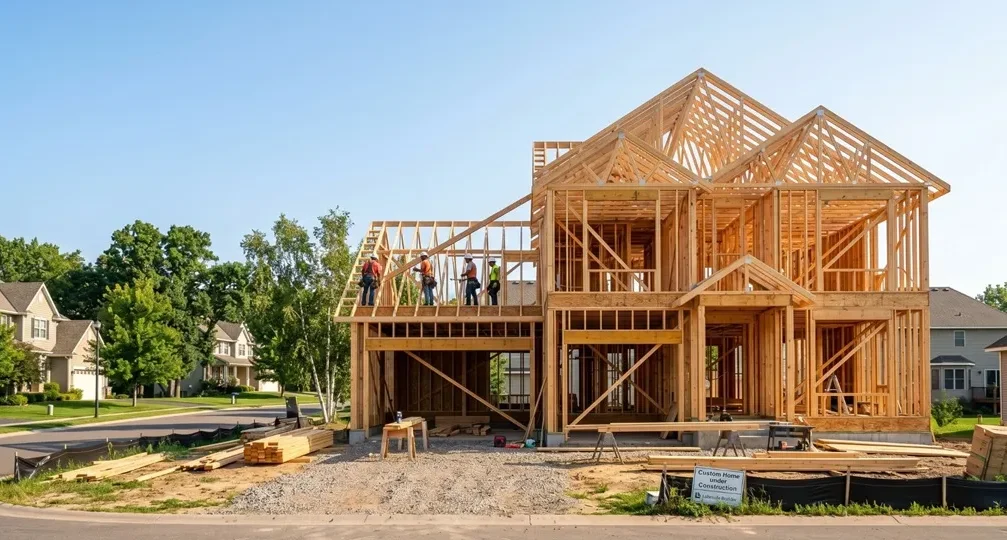
| 3. Framing & Roofing | 4 to 8 weeks | Subfloors, exterior walls, roof trusses, sheathing, and weatherproofing (dried-in stage). |
| 4. Rough-In Utilities | 3 to 6 weeks | Installing plumbing pipes, electrical wiring, HVAC ductwork, and gas lines. |
| 5. Insulation & Drywall | 3 to 4 weeks | Adding thermal insulation, hanging drywall, taping, mudding, and priming. |
| 6. Interior Finishes & Trim | 4 to 8 weeks | Installing flooring, cabinetry, countertops, interior doors, baseboards, and painting. |
| 7. Fixtures & Final Details | 2 to 4 weeks | Light fixtures, plumbing hardware, appliances, mirrors, and final cleaning. |
| 8. Inspections & Walkthrough | 2 to 4 weeks | Final building code inspections, punching out the contractor’s checklist, and issuing a Certificate of Occupancy. |
A Simple Formula to Calculate Your Custom Timeline
If you are planning a custom home, you can estimate your core construction duration using a standard industry rule of thumb based on square footage:
Rule of Thumb
Expect roughly 1 month of construction for every 500 to 1,000 square feet, plus an additional 2 to 3 months for pre-construction, permitting, and finishing.
Calculation Example:
- Home Size: 3,000 square feet
- Construction Estimate: ~4 to 6 months
- Pre-Construction & Permitting: ~2 months
- Buffer for Finishes & Inspections: ~2 months
- Total Estimated Timeline: 8 to 10 months
Key Factors That Can Disrupt Your Timeline
Even the best-calculated timelines can hit roadblocks. When mapping out your schedule, account for these major variables:
Permitting and Zoning Delays
Local municipal offices operate at their own pace. Plan review, zoning approvals, and environmental checks can add weeks or even months before you ever break ground.
Weather Conditions
Heavy rain, freezing winter temperatures, or extreme heat waves can halt outdoor work like excavation, foundation pouring, and roofing.
Supply Chain and Material Shortages
Specialty items—such as custom windows, imported tile, or specific cabinetry—can backorder and delay subsequent trades (e.g., you can’t install flooring if the trim work isn’t done).
Labor Shortages
Subcontractor availability (electricians, plumbers, drywallers) heavily dictates whether work flows seamlessly from one week to the next.
Pro-Tips to Keep Your Build on Schedule
Want to ensure your home finishes on time? Use these proven strategies to protect your timeline:
Finalize Plans Before Building
Making design changes or “change orders” halfway through framing is the #1 cause of construction delays and budget overruns.
Order Materials Early
Purchase long-lead items (appliances, windows, custom doors) before construction starts so they are sitting in a warehouse ready for installation.
Build in a Buffer
Always add a 15% to 20% time buffer to your total calculated schedule to account for unexpected weather, supply issues, or inspection delays.
Hire an Experienced General Contractor
A seasoned contractor has established relationships with reliable subcontractors and knows how to streamline the scheduling sequence.
Conclusion
Calculating your home construction time requires balancing the math of square footage with the realities of local permits and weather. By breaking the project down into distinct phases and adding a healthy buffer for unexpected delays, you can establish a realistic timeline that gets you into your dream home with minimal stress.